


POTS and Your Period: Why Symptoms May Worsen During Menstruation
Your period may bring more than cramps. For some people with POTS, the days before or during menstruation bring increased lightheadedness, fatigue, and difficulty staying upright — making everyday activities harder to manage.
Research reagrding this recurring pattern and suggests that hormonal changes may influence fluid regulation and circulation. Symptoms and standing tolerance may change even when heart rate and blood pressure readings look similar. This clinical presentation is not uncommon in POTS patietns.
Your experience deserves attention and an individualized plan.
Recognize your pattern. Plan for difficult days. Know when bleeding or new symptoms need further evaluation.
Recognizing Your Menstrual Symptom Pattern
If your POTS symptoms become more difficult before or during your period, noticing the timing can help you plan. Research has found that lightheadedness often peaks during menstruation, although the timing and severity vary from person to person.
You may notice:
Less tolerance for standing: Showering, preparing meals, or waiting in line becomes harder.
More lightheadedness: You need to sit or lie down sooner than usual.
Greater disruption to daily activities: Your usual school, work, or rehabilitation routine requires more breaks.
Keep a brief record across two or three menstrual cycles. Note when bleeding starts, when symptoms increase, which activities become difficult, and when you return to your usual baseline. Record symptoms alongside heart rate and blood pressure if these measurements are already part of your care plan.
A recurring pattern gives your care team something concrete to work with—and gives you an opportunity to prepare before the next difficult day.
Why Your Period May Affect POTS
Estrogen and progesterone change throughout the menstrual cycle. These hormones may influence blood vessel functions and the systems that regulate salt and water retention—helping explain why standing can feel more difficult during certain phases.
In a small study of 10 women with POTS and 11 healthy women, researchers compared the first days of menstruation with a later phase of the cycle. During prolonged standing, women with POTS had:
Lower stroke volume: Less blood pumped with each heartbeat during early menstruation.
Lower cardiac output: Less blood pumped by the heart each minute.
Lower renin and aldosterone responses: Differences in hormones involved in regulating fluid balance.
These circulation differences appeared after more than 30 minutes of standing. Heart rate and blood pressure were similar between phases, showing that those measurements alone may not capture every change in the body’s response to being upright.
The findings support a possible hormonal influence on standing tolerance. They do not establish menstrual blood loss as the cause, and the study did not directly measure symptom severity during testing.
Your symptom pattern and ability to function matter alongside your heart rate and blood pressure readings.
Source: Fu et al., Hypertension, 2010.
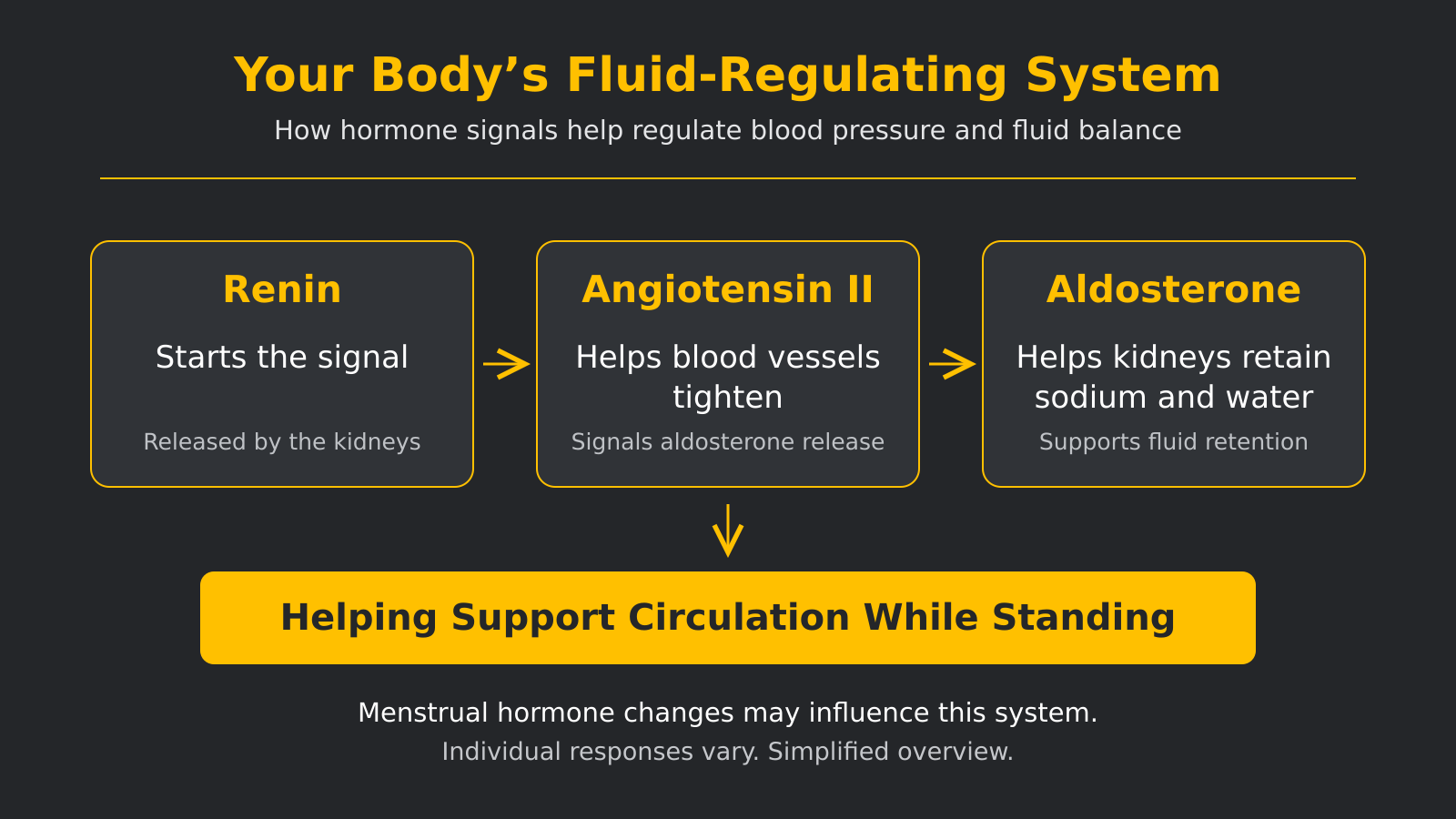
A simplified view of how the body regulates blood vessel tone and fluid retention. Menstrual hormone changes may influence this system.
Your Body’s Fluid-Regulating System
Your body uses a coordinated hormone system—called the renin–angiotensin–aldosterone system—to help regulate blood pressure and fluid balance.
Think of it as part of your body’s response to a circulation challenge. Renin starts the signal, angiotensin helps blood vessels tighten, and aldosterone tells the kidneys to retain sodium and water. Together, these actions help support circulation when you stand.
Estrogen and progesterone may influence this system. In the Fu study, women with POTS had lower renin and aldosterone responses during early menstruation than later in the cycle. They also pumped less blood with each heartbeat during prolonged standing, even though heart rate and blood pressure were similar between phases.
This suggests that the body’s support for standing can change across the menstrual cycle without an obvious change on your monitor. The study did not establish that angiotensin itself was responsible or that every patient experiences the same mechanism.
Source: Fu et al., Hypertension, 2010.
Planning Ahead for Difficult Days
A recurring menstrual flare gives you an opportunity to prepare. Use your cycle and symptom record to develop a practical plan with your care team—one that reflects how you feel and what you can comfortably manage.
Your plan may include:
Adjusting time upright: Break up standing tasks, prepare meals seated, and arrange breaks before symptoms become overwhelming.
Planning demanding activities: When possible, schedule longer outings or physically demanding tasks during your more manageable days.
Following your established care plan: Keep prescribed fluid, sodium, compression, and medication routines consistent. Discuss any temporary changes with the clinician managing that treatment.
Adapting rehabilitation: Ask your rehabilitation clinician how to adjust exercise duration, intensity, or position during a flare.
Communicating your needs: Let family, school, or workplace supports know when symptoms predictably affect your capacity.
Track whether these adjustments help and how quickly you return to your usual baseline. If a flare becomes more severe, lasts longer, or feels different from your established pattern, bring that change to your care team’s attention.
Plan around your capacity. A difficult day deserves an appropriate adjustment—not pressure to push through.
When Bleeding or Pain Needs Further Evaluation
A menstrual flare may be part of your POTS pattern, but heavy bleeding, disabling pain, or new symptoms deserve their own assessment. Attributing every change to POTS can delay recognition of another treatable problem.
Arrange an evaluation with your prescribing or gynecologic clinician if you experience:
Heavy or prolonged bleeding: Flow that interferes with daily life, frequent flooding, or bleeding lasting longer than seven days.
Disabling menstrual pain: Pain that repeatedly prevents school, work, sleep, or usual activities.
Unexpected bleeding: Bleeding between periods or a substantial change from your usual cycle.
Persistent symptoms: Fatigue, dizziness, or reduced activity tolerance that continues beyond your usual menstrual flare.
Heavy menstrual bleeding can cause iron-deficiency anemia. Depending on your history and symptoms, your clinician may recommend a complete blood count and ferritin testing to assess anemia and iron stores.
Seek emergency care if you are changing a pad or tampon every hour for more than two consecutive hours and also have chest pain, shortness of breath, or lightheadedness or dizziness. Do not assume this is your usual POTS flare.
Discussing Menstrual Management With Your Care Team
If menstrual flares repeatedly interfere with school, work, or rehabilitation, discuss treatment options with your prescribing or gynecologic clinician. Your POTS care team can contribute information about your symptom pattern, standing tolerance, and current treatment.
Hormonal contraception may help some patients, but it is not an established treatment for POTS. In the 2025 survey, some participants reported improvement while using hormonal contraception; others reported no change or worsening. Because this was a questionnaire study, it cannot establish that treatment caused improvement or determine which option works best.
Bring your cycle record and medication list, and discuss:
Your main concern: Heavy bleeding, pain, predictable POTS flares, contraception, or a combination.
Your treatment goals: Fewer disruptive days, better daily function, or improved participation in rehabilitation.
Your medical history: Factors that affect the suitability and risks of different options.
How to assess the result: What improvement would look like and when to review benefits or unwanted effects.
The goal is an individualized decision, followed by a clear plan to evaluate whether it helps you.
Build a Plan Around Your Symptoms
When your period repeatedly makes standing, working, or participating in rehabilitation harder, that pattern deserves a place in your care plan.
At NeuroSport Spine & Concussion Center in Vancouver, Washington, we evaluate how POTS and dysautonomia affect your daily function. Your menstrual symptom record can help guide discussions about standing tolerance, activity adjustments, and rehabilitation during more difficult days. We will collaberate with your current healthcare team working together to help you.
Bring your cycle record, current medication list, and the activities you want to manage more comfortably. We can help you develop practical recommendations and coordinate care with your prescribing or gynecologic clinician when menstrual treatment or further evaluation is needed.
A predictable flare deserves recognition—and a plan that fits your life.
Further Reading
Explore the research behind menstrual symptom patterns in POTS and guidance on when bleeding needs evaluation.
Menstrual Cycle Affects Renal-Adrenal and Hemodynamic Responses During Prolonged Standing in POTS
Fu et al. Hypertension, 2010. A small physiologic study examining circulation and fluid-regulating hormones during two menstrual phases.Gynecologic Disorders and Menstrual Cycle Lightheadedness in POTS
Peggs et al. International Journal of Gynecology & Obstetrics, 2012. A questionnaire study examining lightheadedness across the menstrual cycle.Long-Term POTS Outcomes Survey: Gynecologic Findings
Boris et al. Obstetrics and Gynecology International, 2025. Self-reported menstrual symptoms and treatment experiences among young women previously followed in a pediatric POTS program.Heavy Menstrual Bleeding
American College of Obstetricians and Gynecologists. Patient guidance on heavy bleeding, possible causes, and iron-deficiency anemia.Abnormal Uterine Bleeding
American College of Obstetricians and Gynecologists. Guidance on unexpected bleeding and symptoms requiring urgent medical attention.