


Why Symptoms Fluctuate in POTS & Dysautonomia
Understanding Why Symptoms Can Change From Hour to Hour or Day to Day
Symptoms of POTS and dysautonomia often fluctuate because the autonomic nervous system is responsible for constantly adapting to posture, hydration, temperature, sleep, illness, stress, exertion, and recovery demand. When this system becomes unstable, even small changes in physiologic demand may trigger dizziness, fatigue, brain fog, rapid heart rate, nausea, heat intolerance, or post-exertional symptom flares.
Why Symptom Variability Is So Common
One of the most confusing aspects of POTS and dysautonomia is that symptoms rarely remain constant. Many patients expect that if they have a medical condition, symptoms should be predictable from day to day. Instead, they often experience periods of relative stability followed by unexpected symptom worsening that may seem difficult to explain.
In reality, symptom variability is one of the hallmark characteristics of autonomic dysfunction. The autonomic nervous system continuously regulates heart rate, blood pressure, circulation, breathing, temperature control, digestion, and recovery physiology. Unlike many body systems that remain relatively stable throughout the day, the autonomic nervous system must constantly adjust to changing internal and external demands.
These demands may include:
Changes in body position
Hydration status
Heat exposure
Sleep quality
Illness or inflammation
Physical activity
Cognitive exertion
Emotional stress
Hormonal fluctuations including menstruation
Travel and environmental changes
For healthy individuals, these adjustments occur automatically and efficiently. In patients with autonomic dysfunction, however, the system may have difficulty adapting appropriately to these changing demands.
As a result, symptoms may fluctuate significantly even when the underlying condition itself has not changed.
Understanding this concept is important because symptom variability does not necessarily mean a patient is improving, worsening, exaggerating symptoms, or imagining symptoms. In many cases, fluctuating symptoms simply reflect the challenges of an autonomic nervous system that is struggling to maintain physiologic stability under changing conditions.
The Physiologic Triggers Behind Symptom Flares
Although symptoms may sometimes seem unpredictable, symptom fluctuations are often linked to identifiable physiologic stressors. These triggers do not necessarily cause dysautonomia itself, but they may increase physiologic demand and temporarily overwhelm an already stressed autonomic nervous system.
One useful way to think about dysautonomia is that the nervous system may have a smaller margin for adaptation. Activities or stressors that a healthy individual tolerates easily may create disproportionate physiologic strain in someone with autonomic dysfunction.
Common triggers include:
Heat Exposure
Heat causes blood vessels to dilate, which can increase blood pooling and reduce blood return to the heart. This often worsens dizziness, fatigue, exercise intolerance, and upright symptoms.
Dehydration
Even mild dehydration may significantly impact blood volume and circulation. Many patients notice symptom worsening during hot weather, travel, illness, or periods of inadequate fluid intake.
Poor Sleep
Sleep is one of the body's most important recovery mechanisms. Inadequate or disrupted sleep may reduce physiologic reserve and increase symptom sensitivity the following day.
Physical Exertion
Exercise and activity are important for long-term health, but exertion that exceeds a patient's current physiologic capacity may contribute to symptom flares, fatigue, dizziness, and delayed recovery.
Cognitive Overload
Extended concentration, screen time, multitasking, academic demands, or mentally intensive work can create physiologic stress similar to physical activity in some individuals with autonomic dysfunction.
Illness and Inflammation
Viral illnesses, infections, allergies, and other inflammatory stressors commonly worsen autonomic symptoms and may temporarily reduce physiologic stability.
Emotional Stress
Stress activates autonomic pathways that influence heart rate, circulation, hormone regulation, and recovery physiology. Persistent stress may contribute to increased symptom variability in susceptible individuals.
Understanding these triggers can help patients identify patterns, improve pacing strategies, and make more informed decisions regarding activity, recovery, hydration, sleep, and symptom management.
Why Some Days Are Better Than Others
A common question among patients with POTS and dysautonomia is:
"Why can I feel relatively normal one day and significantly worse the next?"
The answer often lies in the cumulative nature of physiologic stress. Most patients are not responding to a single trigger. Instead, symptom severity may reflect the combined effects of multiple factors occurring over hours or days. A patient may tolerate one physiologic stressor reasonably well, but several occurring together can exceed the body's current adaptive capacity.
For example, a patient may experience:
A poor night of sleep
Increased work or school demands
Mild dehydration
Heat exposure
Increased physical activity
Emotional stress
Each factor may contribute only a small amount of physiologic strain. However, when combined, they can significantly increase autonomic workload and reduce physiologic reserve. This concept helps explain why symptom worsening may sometimes seem disconnected from a specific event. The flare may actually represent the cumulative effect of several stressors that have gradually taxed the nervous system over time.
Many patients also experience what is often described as a "good day, bad day" pattern. Feeling better on a particular day does not necessarily mean the underlying condition has resolved. Likewise, a symptom flare does not automatically indicate permanent worsening. Instead, these fluctuations often reflect changes in how effectively the autonomic nervous system is managing current physiologic demands.
Recognizing this pattern can be helpful because it shifts the focus away from searching for a single cause and toward understanding the broader factors that influence autonomic stability. For many patients, successful management involves improving physiologic resilience while reducing the cumulative burden of stressors that contribute to symptom variability.
The Role of Recovery Capacity
One of the most overlooked aspects of dysautonomia is recovery capacity.
Most people think about symptoms in terms of what they can do. Equally important, however, is how efficiently the body recovers after physical, cognitive, emotional, or environmental stress.
In healthy individuals, physiologic systems typically return to baseline relatively quickly following activity or stress exposure. Heart rate normalizes, autonomic balance is restored, energy reserves are replenished, and recovery mechanisms help prepare the body for future demands.
In patients with POTS and dysautonomia, this recovery process may be less efficient.
As a result, patients may experience:
Prolonged fatigue after activity
Delayed recovery following exercise
Symptom worsening hours after exertion
Reduced tolerance for consecutive busy days
Increased sensitivity to stressors
Difficulty returning to baseline after symptom flares
This reduced recovery capacity helps explain why two patients with similar activity levels may experience very different outcomes. One individual may recover quickly, while another may experience symptoms for hours or even days afterward.
Recovery capacity can also fluctuate over time. Factors such as sleep quality, hydration status, nutrition, illness, stress, environmental conditions, and overall autonomic stability may all influence how effectively the body recovers from physiologic demand.
For many patients, improving recovery capacity becomes an important part of long-term management. This often involves balancing activity exposure with appropriate recovery, pacing demands, optimizing sleep, supporting hydration, and gradually improving physiologic resilience over time.
Understanding recovery capacity helps shift the conversation beyond simply asking, "What triggered my symptoms?" and toward a more important question:
"How well is my nervous system recovering from the demands being placed upon it?"
Building Physiologic Reserve
While symptom fluctuations can be frustrating, they do not necessarily mean recovery is impossible. One of the primary goals of rehabilitation in dysautonomia is to gradually improve physiologic reserve and increase the body's capacity to tolerate daily demands.
Physiologic reserve refers to the body's ability to adapt to physical, cognitive, emotional, and environmental stress while maintaining stable function. Individuals with greater physiologic reserve generally recover more efficiently from exertion, tolerate stress more effectively, and experience fewer symptom fluctuations.
For patients with dysautonomia, improving physiologic reserve often requires a gradual and structured approach.
Key components may include:
Optimizing hydration and electrolyte intake
Improving sleep quality and recovery habits
Managing heat exposure and environmental stressors
Developing effective pacing strategies
Gradually increasing physical activity within tolerable limits
Improving autonomic conditioning through structured rehabilitation
Reducing large fluctuations in daily activity levels
Supporting overall cardiovascular and physiologic resilience
Importantly, building physiologic reserve is rarely a linear process. Most patients experience periods of progress interspersed with temporary setbacks, symptom flares, illness, travel demands, life stressors, or changes in routine.
These fluctuations do not necessarily indicate failure. In many cases, they represent a normal part of the recovery process as the autonomic nervous system gradually becomes more resilient and adaptable.
Rather than focusing solely on individual symptom spikes, it is often more helpful to evaluate trends over weeks and months. Many patients ultimately find that symptom flares become less frequent, less severe, and easier to recover from as physiologic reserve improves over time.
The NeuroSport Perspective on Symptom Fluctuation
At NeuroSport, symptom fluctuation is viewed as an important clinical observation rather than a sign that symptoms are inconsistent or unexplained.
The autonomic nervous system is responsible for helping the body adapt to constantly changing demands. When that system becomes dysregulated, variability often becomes part of the clinical picture. Symptoms may worsen during periods of increased physiologic stress and improve when recovery capacity is restored.
This is one reason why understanding patterns often becomes more valuable than focusing on individual symptom episodes.
Evaluation may include assessment of:
Orthostatic response patterns
Activity tolerance
Recovery capacity
Exercise response
Heat sensitivity
Hydration status
Sleep quality
Symptom triggers
Post-exertional symptom patterns
Overall autonomic function
The goal is not simply to identify when symptoms worsen, but to better understand why they worsen and what physiologic factors may be contributing to symptom variability.
For many patients, symptom fluctuations become less confusing once they recognize the relationship between autonomic regulation, physiologic reserve, recovery capacity, and daily stressors. Understanding these relationships often provides a more useful framework for navigating recovery than focusing on isolated symptom changes alone.
Symptoms May Be Fluctuating, But They Are Often Not Random
One of the most important messages for patients with POTS and dysautonomia is that symptom fluctuations are often driven by identifiable physiologic factors rather than occurring completely at random.
While symptoms may sometimes feel unpredictable, many patients eventually begin to recognize patterns involving sleep, hydration, heat exposure, illness, stress, physical activity, cognitive demands, travel, or recovery capacity. Understanding these relationships can help transform symptom management from a frustrating guessing game into a more informed and strategic process.
Importantly, fluctuating symptoms do not necessarily mean a patient is getting worse. Likewise, a temporary improvement does not always mean the underlying condition has fully resolved. In many cases, symptom variability reflects the ongoing interaction between autonomic regulation, physiologic reserve, recovery capacity, and the demands being placed upon the body.
The goal is not to eliminate every symptom fluctuation. Rather, it is to improve physiologic resilience, strengthen recovery capacity, identify major triggers, and gradually increase the body's ability to tolerate daily demands with fewer and less severe symptom disruptions.
For many patients, understanding why symptoms fluctuate is the first step toward understanding how recovery can occur.
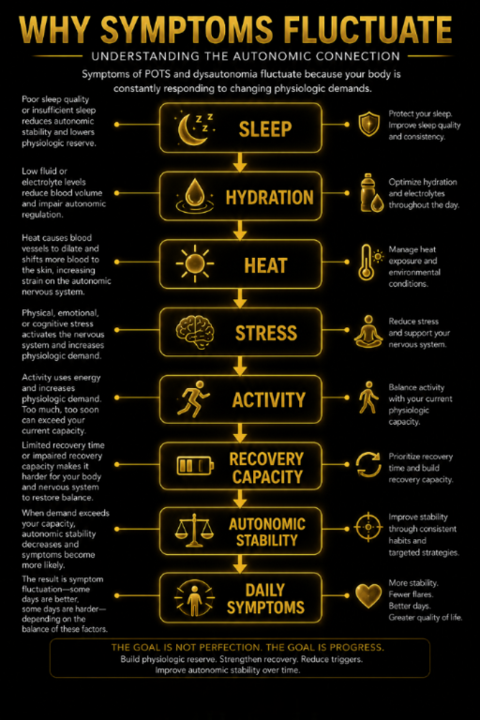
Why Understanding Patterns Matters
Many patients spend months or even years searching for a single explanation for their symptom fluctuations. They may wonder why they felt well enough to attend work, school, practice, or social activities one day, only to experience a significant symptom flare shortly afterward.
In reality, dysautonomia often behaves less like an on-off condition and more like a dynamic physiologic system that is constantly responding to changing demands. This is why tracking patterns can be so valuable. Patients frequently discover that symptom fluctuations are associated with combinations of factors such as:
Sleep quality
Hydration status
Electrolyte intake
Heat exposure
Activity level
Recovery time
Travel
Illness
Stress
Hormonal changes
Environmental conditions
Over time, these observations often provide greater insight than focusing on any single symptom episode.
Many patients also find it helpful to think in terms of physiologic capacity rather than symptom elimination. The question becomes less:
"Why did I have symptoms today?"
and more:
"What factors may have reduced my physiologic reserve or increased my physiologic demand?"
This shift in perspective often helps patients make more informed decisions regarding pacing, recovery, exercise progression, hydration strategies, sleep habits, and daily activity planning.
At NeuroSport, identifying these patterns is often an important part of helping patients better understand their condition and develop strategies that support greater physiologic stability over time.
The NeuroSport Approach to Managing Symptom Variability
At NeuroSport, management focuses on helping patients better understand the factors influencing autonomic stability while gradually improving physiologic resilience over time.
Because symptom fluctuations are often influenced by multiple interacting variables, effective management rarely depends on a single intervention. Instead, successful recovery strategies typically involve addressing several areas simultaneously.
Depending on the patient's presentation, recommendations may include:
Hydration and electrolyte optimization
Sleep improvement strategies
Structured pacing techniques
Activity modification during symptom flares
Exercise progression matched to physiologic capacity
Heat management strategies
Recovery planning following periods of increased demand
Identification of individual symptom triggers
Autonomic rehabilitation when appropriate
An important goal is helping patients avoid the common cycle of overexertion followed by prolonged recovery. Many individuals naturally increase activity substantially on days when they feel better, only to experience significant symptom worsening afterward.
Learning how to balance activity, recovery, and physiologic demand often becomes an important component of long-term success.
While symptom fluctuations may never disappear completely, many patients find that understanding their physiologic patterns allows them to make more informed decisions, improve recovery consistency, and gradually expand their tolerance for daily activities over time.
Persistent Symptoms Despite a “Good Day”?
One of the most common mistakes patients make is assuming that a good day means the condition has resolved or that the nervous system is fully prepared for normal activity levels.
When symptoms improve, it is natural to want to catch up on exercise, work, school, household projects, travel, social activities, or other responsibilities that may have been limited during a flare. However, sudden increases in activity can sometimes exceed the body's current recovery capacity and trigger symptom worsening afterward.
This pattern is particularly common in POTS and dysautonomia because symptom improvement does not always occur in a straight line. Recovery often involves gradual improvements in physiologic reserve with occasional fluctuations along the way.
Many patients describe a cycle that looks something like this:
Symptoms improve
Activity increases substantially
Physiologic demand exceeds current capacity
Symptoms flare
Recovery time increases
Activity is reduced again
Understanding this pattern can help patients make more informed decisions during periods of improvement. Rather than viewing a good day as an opportunity to return immediately to full activity, it may be more helpful to view it as an opportunity to carefully and progressively increase activity while continuing to respect recovery needs.
Over time, this approach often helps build greater physiologic resilience while reducing the likelihood of large symptom swings and post-exertional setbacks.
When to Seek Evaluation
While symptom fluctuations are common in POTS and dysautonomia, it is important to recognize that not every symptom change should automatically be attributed to autonomic dysfunction. Patients should communicate with their healthcare team when symptoms change significantly, new symptoms develop, or the overall clinical picture no longer follows established patterns.
Examples that may warrant additional evaluation include:
New chest pain or chest pressure
Loss of consciousness or unexplained syncope
Significant changes in neurologic function
Progressive weakness
Persistent shortness of breath
Marked changes in exercise tolerance
New cardiac symptoms
Unexplained weight loss
Significant changes in blood pressure patterns
Symptoms that differ substantially from previous autonomic presentations
One challenge for patients with chronic autonomic disorders is distinguishing between expected symptom variability and the development of a new medical issue. This is one reason why ongoing communication with qualified healthcare providers remains important.
Understanding symptom fluctuation should never mean dismissing new or concerning symptoms. Rather, it provides a framework for understanding the normal variability that commonly occurs in autonomic disorders while still recognizing situations that may require further medical assessment.
For many patients, gaining confidence in recognizing their own symptom patterns becomes an important step toward navigating daily life with greater clarity, reduced anxiety, and improved self-management.
The NeuroSport Perspective on Recovery
Recovery from POTS and dysautonomia is rarely defined by the complete absence of symptoms. More often, recovery is reflected by improvements in function, resilience, recovery capacity, and overall quality of life.
Many patients initially measure progress by asking:
"Do I still have symptoms?"
While this question is understandable, it may not always be the most useful way to assess recovery.
In many cases, meaningful progress is demonstrated by improvements such as:
Increased upright tolerance
Improved exercise capacity
Faster recovery following activity
Fewer symptom flares
Reduced symptom severity
Better tolerance of work or school demands
Improved travel tolerance
Greater participation in daily activities
Increased confidence managing symptoms
Improved overall physiologic stability
Recovery often occurs gradually. Patients may notice improvements in what they are able to do before they notice dramatic changes in how they feel.
For example, an individual may still experience occasional dizziness or fatigue but find they can tolerate a full workday, participate in exercise, travel, or engage in social activities that were previously impossible.
This distinction is important because symptom fluctuations can sometimes obscure meaningful progress. Looking only at individual bad days may make it difficult to recognize the larger trend occurring over weeks and months.
At NeuroSport, emphasis is placed on evaluating both symptoms and function. Understanding how the nervous system responds to activity, recovery, stress, and daily demands often provides a more complete picture of progress than symptom severity alone.
Understanding Symptom Fluctuation Is Often the First Step Toward Recovery
For many individuals with POTS and dysautonomia, one of the most reassuring realizations is that symptom variability is often a recognized feature of autonomic dysfunction rather than evidence that symptoms are imaginary, inconsistent, or impossible to understand.
Although symptom patterns may appear unpredictable at first, many patients eventually discover that fluctuations are influenced by identifiable physiologic factors such as sleep, hydration, heat exposure, illness, stress, activity level, recovery capacity, and overall autonomic stability.
This understanding can be empowering.
Rather than viewing every symptom flare as a setback or every good day as complete recovery, patients can begin to recognize the broader physiologic patterns that influence how they feel and function. Over time, this perspective often supports better pacing decisions, improved recovery strategies, and greater confidence in navigating daily activities.
At NeuroSport, the goal is not simply to help patients understand that symptoms fluctuate. The goal is to help them understand why symptoms fluctuate and how that knowledge can be used to support more consistent physiologic stability, improved function, and long-term recovery.
For many patients, learning to recognize these patterns is one of the most important steps in transforming uncertainty into understanding and frustration into a more effective path forward.
Persistent Symptoms During Symptom Flares?
Symptoms of POTS and dysautonomia often fluctuate because the autonomic nervous system is constantly responding to changes in physiologic demand. Heat exposure, dehydration, poor sleep, illness, stress, activity level, recovery capacity, and environmental factors can all influence how symptoms present from one day to the next.
NeuroSport specializes in structured evaluation for POTS, dysautonomia, concussion-related autonomic dysfunction, exercise intolerance, and persistent symptom patterns. Understanding why symptoms fluctuate is often an important step toward understanding how recovery occurs.
Posture • Hydration • Heat • Sleep • Stress • Exertion • Recovery • Physiologic Reserve
Symptoms Fluctuate. Understanding Helps.
POTS and dysautonomia symptoms are often influenced by sleep, hydration, heat exposure, stress, activity levels, recovery capacity, and overall autonomic stability. Understanding these patterns can help transform uncertainty into a clearer understanding of why symptoms change from day to day.
NeuroSport specializes in structured evaluation for POTS, dysautonomia, concussion-related autonomic dysfunction, exercise intolerance, and persistent symptom patterns. Our approach focuses on identifying the physiologic factors contributing to symptoms and helping patients better understand the relationship between autonomic regulation, recovery capacity, and daily function.
If you are struggling with unexplained symptom fluctuations, persistent dizziness, fatigue, exercise intolerance, brain fog, rapid heart rate, or recurring autonomic symptom flares, a comprehensive evaluation may help identify important contributing factors and provide a clearer path forward.
Related NeuroSport Resources
POTS & Dysautonomia
Understand the autonomic system and why standing, hydration, heat, and exertion matter.Exercise Intolerance After Concussion and Dysautonomia
Learn why symptoms may worsen after activity and how pacing helps.Heat Intolerance and POTS
Understand why heat can amplify heart rate, fatigue, dizziness, and nausea.Traveling to NeuroSport
Plan ahead for hydration, pacing, compression, and post-travel recovery.Moreau POTS Protocol™
Learn how structured autonomic rehabilitation is progressed safely.