


Dysautonomia Flares
Why Symptoms Spike, What It Means, and How to Recover
A dysautonomia flare is not random. If you live with dysautonomia or POTS, you already know what a flare feels like. Heart racing with minimal activity. Dizziness that hits without warning. Mind and soul sapping fatigue; fatigue that makes even the simplest tasks feel overwhelming.
What is often misunderstood is why flares happen and why symptoms can escalate so quickly.
Dysautonomia flares are not random. They occur when your autonomic nervous system exceeds its current capacity.
This is not a setback. It is a threshold breach.
Understanding that pattern changes everything.
When you recognize what pushed your system into overload, you can respond the right way, stabilize faster, and reduce the frequency and severity of future flares.
It is a temporary loss of autonomic stability triggered when your system exceeds its current capacity. At NeuroSport, we identify the cause, stabilize the system, and guide a structured return to function.
Flares are common in dysautonomia, POTS, post-concussion syndrome, and complex autonomic disorders. With the right strategy, they are predictable, manageable, and reversible.
At NeuroSport, we identify what pushed your system into overload, stabilize it, and guide a structured return to function. With the right strategy, flares become predictable, manageable, and reversible.
What Is a Dysautonomia Flare?
A dysautonomia flare is a temporary loss of autonomic stability. It occurs when the autonomic nervous system exceeds its current physiologic capacity and can no longer regulate normally. At NeuroSport, we define a flare as a threshold breach.
This is not random.
This is not a failure.
This is a predictable response to overload.
What Is Actually Happening
Your autonomic nervous system is responsible for regulating:
Heart rate
Blood pressure
Circulation
Temperature control
Digestion
Energy regulation
When functioning well, these systems adjust automatically. During a flare, that regulation breaks down. The result is non-linear symptom escalation:
Symptoms increase rapidly
They feel disproportionate to activity
Recovery takes longer than expected, sometimes much longer
The Key Pattern
Flares follow a consistent clinical pattern:
Symptoms are out of proportion to what you did
Tolerance to activity suddenly drops
Recovery is delayed and incomplete
Multiple systems become involved at once
This is the hallmark of autonomic overload, not disease progression.
Why This Matters
Most patients interpret a flare as:
“I’m getting worse.”
That is usually incorrect. In most cases, a flare means:
You were improving
You increased exposure (activity, stress, demand)
Your system exceeded its current limit
That is a capacity issue, not a deterioration of your condition.
NeuroSport Clinical Perspective
A flare tells us something valuable:
Where your current physiologic limit is
What stressors contributed to overload
How your system responds under strain
This allows us to adjust your care plan with precision.
Bottom Line
A dysautonomia flare is not a step backward.
It is a temporary overload of the autonomic nervous system that requires stabilization before progression can continue.
Handled correctly, it becomes part of the recovery process, not a barrier to it.
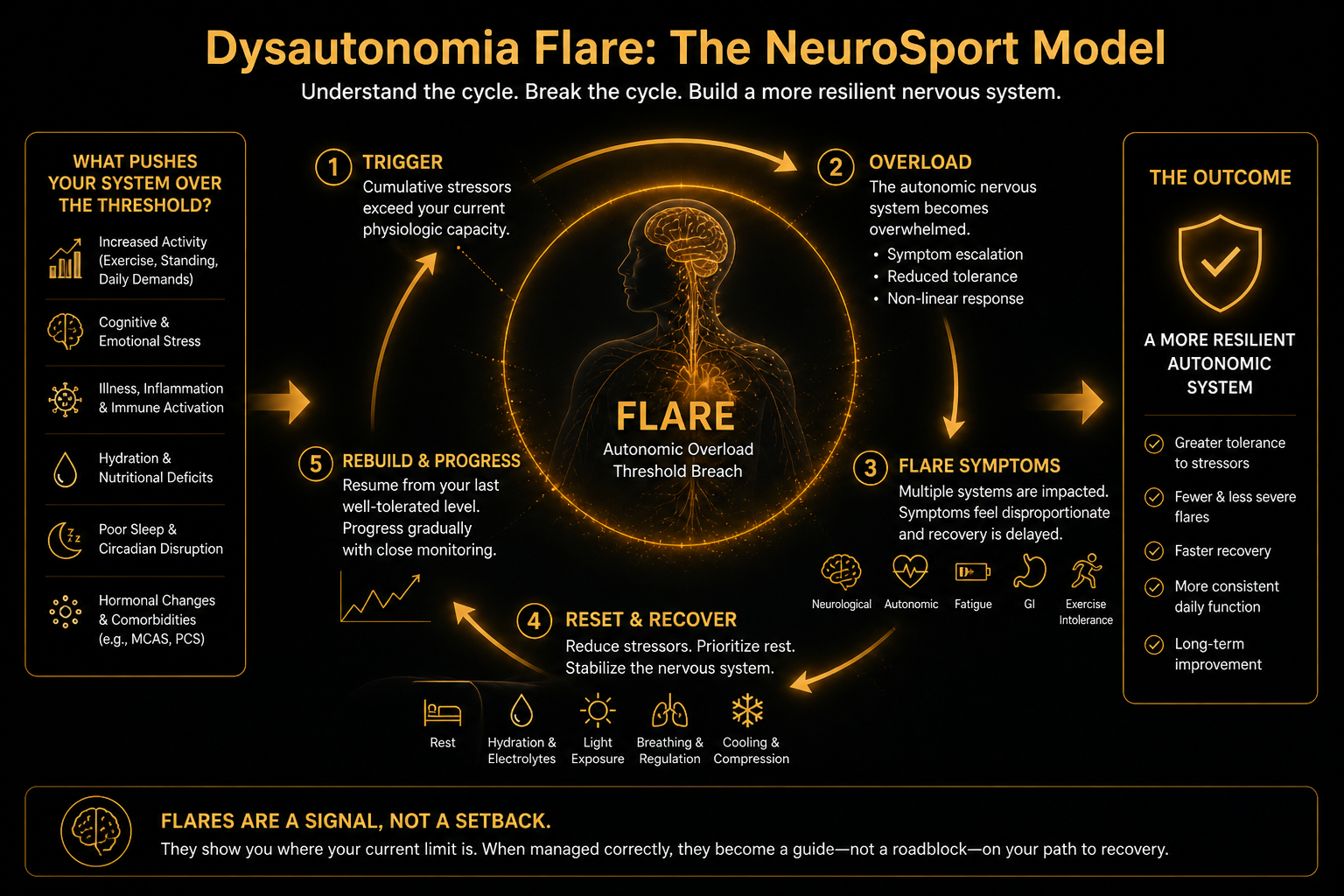
What Does a Dysautonomia Flare Feel Like
A dysautonomia flare is not just one symptom.
It is a multi-system event where the autonomic nervous system loses its ability to regulate normally. Symptoms often come on quickly, feel disproportionate to activity, and affect multiple systems at once.
Common Symptom Clusters
Cardiovascular
Heart racing with minimal activity
Palpitations or pounding heartbeat
Blood pressure instability
Neurological
Dizziness or lightheadedness
Brain fog, slowed thinking, poor concentration
Head pressure or sensory overload
Fatigue and Energy
Sudden, overwhelming fatigue
Rapid depletion of energy reserves
Poor recovery even after rest
Gastrointestinal
Nausea
Appetite disruption
Abdominal discomfort
Temperature and Circulation
Heat intolerance
Cold, discolored hands and feet
Sweating abnormalities
Exercise Intolerance / Reduced tolerance to both:
Dynamic activity (walking, exercise)
Static demand (standing, posture)
The Pattern That Defines a Flare
What makes a flare different from a “bad day” is the pattern:
Symptoms are out of proportion to what you did
Multiple systems are affected at the same time
Tolerance drops suddenly
Recovery is slower than expected
Patients often describe it as:
“I didn’t do anything to cause this.”
“Everything hit at once.”
“I can’t recover like I normally do.”
Why It Feels So Severe
During a flare, the neurocardiac axis is not regulating properly.
Blood flow becomes less efficient
Heart rate compensation increases
Brain perfusion may fluctuate
Energy systems become inefficient
This creates a cascade where:
Symptoms amplify each other
The system becomes more reactive
Recovery requires active intervention, not time alone
Clinical Insight
The severity of symptoms does not always reflect damage.
It reflects dysregulation.
That distinction matters.
Because dysregulation can be stabilized and retrained.
Bottom Line
A dysautonomia flare feels overwhelming because multiple systems lose coordination at the same time. But the pattern is consistent. And when you understand that pattern, you can begin to interrupt it.
What Triggers a Dysautonomia Flare?
Dysautonomia flares are rarely random.
They occur when cumulative stress exceeds your system’s current capacity. In most cases, it is not one single trigger. It is the stacking of multiple stressors that pushes the autonomic nervous system past its threshold.
Common Triggers
Physical and Physiological
Dehydration or low electrolyte intake
Illness or inflammatory states
Hormonal changes (e.g., menstrual cycle)
Activity and Load
Advancing exercise too quickly
Increased daily activity beyond baseline
Prolonged standing or upright posture
Cognitive and Emotional Stress
High mental workload
Emotional stress or anxiety
Sensory overload
Environmental
Travel or schedule disruption
Lifestyle Factors
Poor sleep or disrupted sleep cycles
Alcohol or excessive caffeine
Clinical Factors
Progression within rehabilitation programs (e.g., MPP)
Comorbid conditions such as:
Post-concussion syndrome
Mast cell activation
The Pattern That Matters
Flares are typically triggered by accumulation, not a single event.
Example:
Slight dehydration
Poor sleep
Increased activity
Individually, manageable.
Combined, enough to trigger a flare.
NeuroSport Clinical Perspective
Triggers tell us where your system is vulnerable.
They help identify:
Your current tolerance limits
Which stressors have the greatest impact
How to adjust your progression safely
This is how we reduce both the frequency and severity of future flares.
Bottom Line
A flare is the result of too much demand on a system that is not yet ready for it.
When you understand your triggers, you can stay below that threshold or respond early before a full flare develops.
How to Manage a Dysautonomia Flare
A dysautonomia flare requires a shift in strategy.
This is most definitely not the time to push, progress, or “work through it.” It is the time to downregulate, stabilize, and reset the system.
Phase 1: Immediate Response (First 3–7 Days)
Primary Goal: Stop the overload
Activity
Reduce to essential daily tasks only
Stop progression in exercise or rehabilitation
Do not push through symptoms
Rest Strategy
Build structured rest into the day
Use horizontal or supported positions as needed, especially in the initial stages
Hydration and Electrolytes
Increase fluid intake aggressively
Maintain consistent electrolyte support
Environment
Limit screen time and sensory input
Avoid heat and overstimulating environments
Adjunct Support
Compression garments (if helpful)
Cooling strategies
Breathing-based regulation
Phase 2: Autonomic Reset
Primary Goal: Restore stability
Prioritize recovery over performance
Keep daily routines simple and consistent
Normalize sleep and wake timing
Get morning light exposure within 30 minutes of waking
This phase shifts the system from overload → regulation.
Phase 3: Monitor Recovery
Expected Pattern
Improvement begins within 7–14 days
Gradual return toward baseline tolerance
Reassess if You Notice
No improvement after 7–10 days
Worsening neurological symptoms
New or severe gastrointestinal issues
Inability to perform basic daily activities
Phase 4: Return to Activity
Once symptoms stabilize:
Resume at your last well-tolerated level, not your most recent level
Start low frequency (e.g., 1x/week)
Progress more gradually than before
Watch closely for early signs of overload
What Not to Do
This is where most flares get prolonged:
Continuing exercise during a flare
Ignoring or minimizing symptoms
Restarting too aggressively
Trying to “catch up” after rest
Failing to manage and reduce the “load”
NeuroSport Clinical Perspective
Flares improve faster when they are managed correctly.
Handled well, they:
Resolve more quickly
Provide useful information about your limits
Help guide safer progression moving forward
Handled poorly, they:
Last longer
Recur more frequently
Delay recovery
Bottom Line
Do less now so you can recover faster.
A flare is not something to fight through.
It is something to stabilize, reset, and rebuild from.
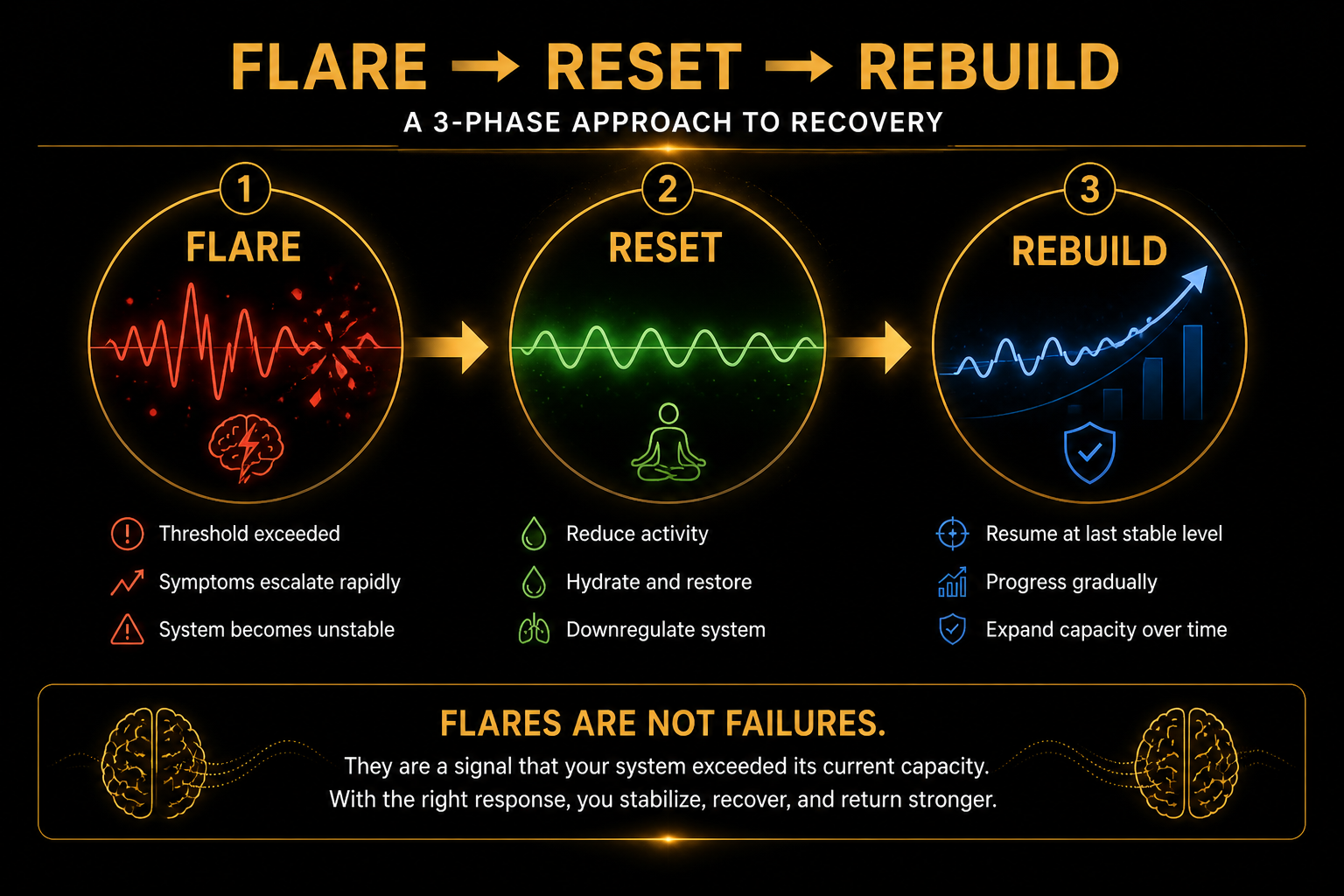
What to Expect: Recovery Timeline and Prognosis
Dysautonomia flares can feel severe, but they are typically self-limited when managed correctly. Understanding the expected pattern helps reduce uncertainty and prevents overreaction.
Typical Recovery Timeline
First 3–7 days: Symptoms stabilize when activity is reduced
7–14 days: Gradual improvement begins
2–3+ weeks: Return toward baseline tolerance
Recovery is usually faster than the initial rehabilitation phase.
What Influences Recovery
Recovery time is not the same for everyone.
It depends on:
Overall autonomic function
Severity of the flare
How quickly the flare is recognized and managed
Sleep quality and hydration
Presence of comorbid conditions (e.g., post-concussion syndrome, mast cell activation)
Important Clinical Reality
A flare does not reset you to the beginning.
It does not mean:
Your condition is worsening
Your treatment is not working
You have lost your progress
In most cases, it means:
You exceeded your current capacity
Your system needs a reset before progressing again
When to Reassess
Most flares improve with appropriate management.
Further evaluation is appropriate if:
Symptoms do not improve within 7–10 days
Neurological symptoms are progressing
New or unusual symptoms appear
Daily function continues to decline
NeuroSport Clinical Perspective
Patients who understand flares recover more efficiently.
They:
Respond earlier
Avoid overcorrection
Progress more consistently over time
This leads to:
Fewer flares
Shorter recovery periods
Better long-term outcomes
Bottom Line
Flares are part of the process, not a deviation from it.
With the right approach, they become:
Shorter
Less severe
Less frequent
Clinical Pearls to Reduce Future Flares
Flares are part of recovery, but they are not random.
Patients who improve long term learn how to recognize patterns and adjust early.
Key Strategies
Respect your current capacity
Progress gradually. Most flares occur after doing too much, too soon.Watch for stacking stressors
Sleep loss, dehydration, and increased activity together are a common setup.Hydrate consistently, not reactively
Waiting until symptoms worsen is too late.Prioritize recovery as part of training
Recovery is not optional. It is part of the protocol.Stabilize before progressing
Do not advance activity unless your system is steady.
Early Warning Signs
Catching a flare early can shorten it significantly:
Rising resting heart rate
Increased fatigue with normal activity
Subtle dizziness or brain fog returning
Reduced exercise tolerance
These are signals to pull back early, not push forward.
Clinical Pearl
Patients often flare after improvement, not before it.
As capacity increases, exposure increases.
That exposure reveals the next limit.
That is part of the process.
Clinical Caution
Flares are prolonged when:
Exercise continues during symptoms
Warning signs are ignored
Recovery is rushed
This turns a short flare into a long one.
Straight Talk
Most patients think a flare means:
“I’m getting worse.”
More often, it means:
You were improving… and exceeded your current limit.
Take Control of Your Recovery
Understanding dysautonomia flares changes how you respond to them.
Instead of reacting with frustration or fear, you can:
Recognize what is happening
Respond early and appropriately
Recover faster
Progress more consistently
If you are experiencing frequent flares or not improving as expected, a structured, individualized approach matters.
Request an Evaluation at NeuroSport
We specialize in complex autonomic cases, including POTS, post-concussion syndrome, and dysautonomia.