

Individualized Concussion Rehabilitation at NeuroSport
Concussion recovery is not a one-size-fits-all process.
NeuroSport uses findings from a comprehensive clinical evaluation to identify the neurological, visual, vestibular, cervical, autonomic, cognitive, and physiological factors limiting recovery. Rehabilitation is then selected, sequenced, and progressed according to the individual patient’s needs.
Two patients may report similar symptoms yet have very different underlying impairments. Likewise, patients with the same diagnosis of concussion may experience markedly different symptoms, functional limitations, and recovery trajectories. The clinical presentation of concussion is highly variable and often multifactorial, reflecting both the specific effects of the brain injury and the individual characteristics of the patient. A comprehensive evaluation is therefore essential for identifying the factors limiting recovery and determining the most appropriate pathway forward.
Concussion Recovery Begins With the Right Evaluation
Effective concussion rehabilitation begins by identifying what is actually preventing recovery.
Dizziness may arise from vestibular dysfunction, visual motion sensitivity, cervical injury, autonomic instability, or several interacting factors. Headache may be influenced by the cervical spine, visual strain, migraine physiology, cognitive demand, exercise intolerance, sleep disruption, or autonomic dysfunction.
Treating the symptom alone does not reveal which system is producing or amplifying it.
At NeuroSport, rehabilitation is guided by findings from a comprehensive concussion evaluation. These findings help determine:
Which impairments should be addressed first
Which rehabilitation methods are most appropriate
How much activity the patient can initially tolerate
Whether treatment should begin with one system before adding another
How exercise, school, work, and daily activity should be progressed
When additional testing or specialty referral may be appropriate
Not every patient requires every form of rehabilitation. The goal is to identify the factors that matter most, establish the correct starting point, and progressively challenge recovery without repeatedly overwhelming the nervous system.
Learn what is included in a comprehensive concussion evaluation
Why Concussion Rehabilitation Must Be Individualized
A concussion diagnosis identifies the injury, but it does not define the rehabilitation plan.
The type, severity, and combination of impairments can differ substantially from one patient to another. One patient may primarily experience dizziness and imbalance related to vestibular dysfunction. Another may struggle with reading, screen use, and visual motion because of impaired ocular coordination. A third may tolerate cognitive activity but develop headache, fatigue, lightheadedness, or symptom escalation when standing or exercising.
Even when patients report the same symptom, the underlying cause may be different. For example:
Headache may be influenced by cervical injury, visual strain, migraine physiology, cognitive demand, sleep disruption, exercise intolerance, or autonomic dysfunction.
Dizziness may arise from vestibular dysfunction, visual motion sensitivity, cervical proprioceptive impairment, orthostatic intolerance, or several overlapping factors.
Fatigue may reflect disrupted sleep, increased cognitive effort, autonomic dysfunction, physical deconditioning, exercise intolerance, or the cumulative demand of daily activity.
Difficulty concentrating may be affected by cognitive load, headache, visual dysfunction, sleep disturbance, anxiety, medication effects, or physiologic intolerance.
Exercise intolerance may involve autonomic dysregulation, abnormal heart-rate behavior, vestibular or visual provocation, cervical dysfunction, or reduced tolerance after a period of inactivity.
Because these symptoms can arise from multiple sources, applying the same rehabilitation protocol to every patient is unlikely to address the specific factors limiting recovery.
At NeuroSport, the rehabilitation plan is based on the patient’s clinical findings, symptom behavior, functional demands, stage of recovery, and response to increasing activity. Treatment is then adjusted as the patient improves, new limitations become apparent, or previously impaired systems become ready for greater challenge.
The goal is not simply to provide more rehabilitation. The goal is to provide the right rehabilitation, in the right sequence, at the right level of intensity.
Building a Recovery Plan From the Clinical Findings
A comprehensive concussion evaluation provides more than a list of symptoms or abnormal findings. It helps identify which systems have been affected, which impairments are limiting function, and how those impairments may be interacting.
Not every finding requires the same level of attention, and not every impairment should be treated at the same time. Some findings represent the primary factors limiting recovery, while others may develop secondarily through pain, reduced activity, visual overload, autonomic dysfunction, or prolonged compensation.
The recovery plan is developed by considering:
The systems most responsible for the patient’s current symptoms
The activities that provoke symptoms and the time required to recover
Tolerance for visual, cognitive, postural, and physical demands
Whether dysfunction in one system is amplifying another
School, work, athletic, and daily-living requirements
The appropriate starting intensity and sequence of rehabilitation
Medical conditions or associated injuries that may affect recovery
The need for additional testing or specialty referral
Based on these findings, rehabilitation may address vestibular and balance function, ocular and visual control, cervical spine dysfunction, exercise tolerance, autonomic regulation, cognitive activity, or a combination of these areas.
The purpose is not to treat every abnormality simultaneously. The purpose is to identify the factors that matter most, establish the correct starting point, and progressively challenge the affected systems without repeatedly overwhelming the patient.
The following sections explain the major components that may be incorporated into an individualized concussion rehabilitation plan.
Restoring Neurological and Movement Function
Vision, balance, head movement, and cervical spine function are closely interconnected. Dysfunction in one area may increase the demands placed on another, contributing to dizziness, headache, visual fatigue, imbalance, motion sensitivity, or difficulty functioning in complex environments.
Rehabilitation may address these systems individually or in combination, depending on the patient’s clinical findings and tolerance.
Vestibular and Balance Rehabilitation
The vestibular system helps the brain interpret movement, stabilize vision, maintain balance, and understand the body’s position in space. Following concussion, vestibular dysfunction may contribute to dizziness, nausea, imbalance, motion sensitivity, difficulty stabilizing vision, or symptoms triggered by head movement and visually busy environments.
Vestibular and balance rehabilitation may include:
Gaze-stabilization exercises
Habituation to symptom-provoking movements
Visual-motion desensitization
Static and dynamic balance training
Head and body movement integration
Progressive exposure to complex environments
Functional movement and return-to-activity exercises
The intensity and complexity of these activities are gradually increased as the patient demonstrates improved control, tolerance, and recovery after activity.
Ocular and Visual Rehabilitation
A patient may have normal visual acuity while still experiencing difficulty with the neurological control and integration of vision. These impairments may contribute to eyestrain, blurred or double vision, headache, dizziness, difficulty reading, reduced screen tolerance, visual motion sensitivity, and cognitive fatigue.
Ocular and visual rehabilitation may address:
Near-point convergence
Accommodation and focusing
Saccadic eye movements
Smooth visual pursuit
Eye-head coordination
Visual tracking
Visual-motion sensitivity
Tolerance for reading and screen use
Visual activities must be introduced at an appropriate level. Excessive visual demand can produce a significant or prolonged symptom exacerbation, while insufficient challenge may fail to promote meaningful adaptation. When more specialized evaluation or treatment is required, referral for neuro-optometric care may be appropriate.
Cervical Spine and Headache Rehabilitation
The cervical spine may contribute to headache, dizziness, imbalance, visual disturbance, restricted movement, and symptoms provoked by head or neck motion. Cervical dysfunction may result from the original injury or develop through protective muscle tension, altered posture, reduced movement, and compensatory strategies. At NeuroSport we use evidence guided testing to identify if cervical spine dysfunction is contributing to the symptom presentation.
Cervical rehabilitation may include:
Restoration of joint mobility through gentle chirorpactic adjustments
Treatment of muscular dysfunction
Cervical stabilization
Postural retraining
Cervical proprioceptive exercises
Coordination of head, eye, and body movement
Progressive tolerance for functional movement
Cervical findings are interpreted as part of the broader concussion presentation. Treatment is coordinated with vestibular, visual, balance, and exercise rehabilitation when dysfunction in these systems overlaps.
The objective is not simply to reduce an individual symptom. It is to restore coordinated function across the visual, vestibular, and cervical systems so the patient can move through daily life with greater stability, confidence, and tolerance.
Repairing the Brain’s Physiological Capacity
Some patients function reasonably well at rest but develop symptoms when they stand, walk, exercise, encounter heat, or sustain physical activity. This pattern may reflect impaired exercise tolerance, autonomic dysfunction, physical deconditioning, or a combination of these factors.
Rehabilitation and recovery must account for how the patient responds during activity, how quickly symptoms increase, and how long recovery takes afterward. A patient who appears stable during an exercise session may still experience a delayed or prolonged exacerbation later that day or the following day.
Exercise and Physiological Rehabilitation
Exercise intolerance is a common feature of persistent concussion. Increasing physical demand may provoke headache, dizziness, nausea, visual symptoms, cognitive slowing, excessive fatigue, or a prolonged worsening of symptoms.
Exercise rehabilitation may include:
Establishing the patient’s initial exercise tolerance
Identifying symptom and heart-rate responses to increasing demand
Beginning with recumbent or upright exercise as clinically appropriate
Subsymptom aerobic conditioning
Progressive increases in exercise duration and intensity
Integration of head, eye, and body movement
Gradual reintroduction of occupational, recreational, and sport-specific demands
Exercise is used as a controlled rehabilitation stimulus, not simply as a test of fitness or determination. The starting level must be challenging enough to promote adaptation without repeatedly producing significant or prolonged symptom exacerbation.
As physiological tolerance improves, exercise can be progressed toward more complex movement, resistance training, changes in direction, dual-task activities, and the specific demands of the patient’s work, recreation, or sport.
Autonomic Rehabilitation
The autonomic nervous system helps regulate heart rate, blood pressure, circulation, temperature control, digestion, pupil response, and the body’s adaptation to standing and exercise. Following concussion, impaired autonomic regulation may contribute to lightheadedness, palpitations, exercise intolerance, heat intolerance, visual dimming, fatigue, or symptoms that worsen with prolonged upright activity.
Autonomic rehabilitation may include:
Hydration and electrolyte strategies
Compression when clinically appropriate
Education regarding heat, prolonged standing, and other triggers
Activity and recovery planning
Recumbent exercise progression
Gradual advancement toward upright exercise
Heart-rate and symptom monitoring
Progressive exposure to postural and physical demands
Autonomic dysfunction is not synonymous with postural orthostatic tachycardia syndrome. A patient may demonstrate orthostatic symptoms, exercise intolerance, or abnormal physiological responses without meeting the diagnostic criteria for POTS.
The purpose of autonomic assessment and rehabilitation is not to assign the same diagnosis to every symptomatic patient. It is to determine whether impaired autonomic regulation is contributing to the concussion presentation and whether it should influence exercise selection, rehabilitation progression, or the need for further evaluation.
Rebuilding physiological capacity requires more than increasing exercise volume. It requires a structured progression that accounts for cardiovascular demand, upright tolerance, autonomic regulation, symptom behavior, and recovery after activity.
Returning to Cognitive and Daily Demands
Recovery from concussion is not measured only by how a patient feels while resting in a quiet environment. Meaningful recovery requires the ability to tolerate the cognitive, visual, physical, and environmental demands of daily life.
A patient may feel relatively well at home but struggle when attempting to read, use a computer, attend school, return to work, drive, shop in a busy store, manage multiple tasks, or sustain activity throughout the day. These difficulties may reflect cognitive fatigue, visual dysfunction, sensory overload, headache, sleep disturbance, autonomic dysfunction, or several interacting factors.
Cognitive and Activity Progression
Cognitive rehabilitation is not limited to memory exercises. It may also address the patient’s tolerance for sustained attention, reading, screen use, multitasking, problem-solving, noise, visual complexity, and prolonged mental effort.
Rehabilitation may include:
Structured pacing of cognitive activity
Planned periods of activity and recovery
Gradual increases in reading and screen exposure
Progressive tolerance for noise and visually complex environments
Strategies for attention, organization, and task completion
Coordination of cognitive and physical activity
Modification of environmental triggers
Gradual reduction of accommodations as tolerance improves
The objective is not prolonged avoidance of symptoms or complete withdrawal from activity. It is to reintroduce meaningful demands in a controlled manner that promotes adaptation without repeatedly producing significant or prolonged symptom exacerbation.
Return to School and Learning
Returning to school may require temporary adjustments to attendance, workload, screen exposure, testing, reading, note-taking, noise, lighting, and physical activity. These supports should reflect the student’s current functional limitations and be modified as tolerance improves.
Progression may include:
Partial school attendance
Scheduled recovery periods
Reduced assignments or extended deadlines
Temporary testing modifications
Reduced screen and visual workload
Gradual return to physical education and extracurricular activity
Progressive removal of accommodations as function improves
The objective is to maintain meaningful participation while avoiding a cycle of excessive demand followed by prolonged symptom worsening.
Return to Work
Work demands vary considerably. Some patients must tolerate prolonged screen use and sustained concentration, while others must manage driving, lifting, noise, rapid decision-making, complex environments, or physically demanding activity.
A return-to-work plan may involve:
Modified hours
Reduced cognitive or physical workload
Scheduled recovery periods
Temporary changes in screen exposure or work environment
Restrictions on driving, heights, machinery, or safety-sensitive duties when appropriate
Gradual restoration of full responsibilities
Work progression should be based on functional capacity and the specific demands of the patient’s occupation rather than diagnosis alone.
Return to Recreation and Sport
Return to exercise is not the same as readiness to return to unrestricted sport. Athletic participation may require cardiovascular fitness, rapid head and eye movements, balance, reaction time, decision-making, coordination, contact tolerance, and the ability to perform under fatigue.
Return-to-sport rehabilitation may progress through:
Aerobic conditioning
Sport-specific movement
Increased speed and directional change
Balance and coordination challenges
Cognitive-motor and dual-task activities
Noncontact training
Controlled return to full practice
Medical clearance before unrestricted contact or competition when required
The final stage of rehabilitation should reflect the actual demands of the activity the patient intends to resume. Recovery is not complete simply because symptoms have improved at rest. The patient must demonstrate the capacity to function safely and effectively in the environments that matter to them.
Treatment Is Often Sequenced, Not Delivered All at Once
Concussion may affect several interacting systems, but that does not mean every impairment should be challenged simultaneously.
Each rehabilitation activity places a demand on the nervous system. Visual exercises, head movement, balance training, cognitive tasks, upright posture, and cardiovascular exercise may be tolerated individually but become overwhelming when combined too early. The order in which these activities are introduced can therefore be as important as the activities themselves.
Sequencing decisions may include:
Stabilizing severe headache or cervical dysfunction before increasing head-movement activities
Improving basic visual tolerance before introducing visually complex environments
Beginning exercise in a recumbent position when upright activity produces orthostatic symptoms
Establishing cardiovascular tolerance before adding rapid movement or sport-specific demands
Reducing competing cognitive demands while introducing a new physical challenge
Building tolerance in one system before combining it with another
Allowing adequate recovery before increasing intensity, duration, or complexity
The appropriate sequence is different for each patient. A person with prominent vestibular dysfunction may initially require a different plan than someone whose primary limitations involve exercise intolerance, cervical injury, visual dysfunction, or autonomic instability.
Rehabilitation Dosage Matters
More rehabilitation is not always better rehabilitation.
The clinical dosage of an activity includes its intensity, duration, frequency, complexity, and the amount of recovery provided afterward. Progressing several of these variables at the same time can make it difficult to determine what caused a symptom exacerbation and may exceed the patient’s current capacity.
Progression may involve changing one variable at a time:
Increasing the duration of an activity
Increasing movement speed
Adding head or eye movement
Moving from a stable to a less stable surface
Advancing from recumbent to upright exercise
Increasing cardiovascular intensity
Adding visual or auditory complexity
Combining cognitive and physical tasks
Reducing recovery time between activities
The patient’s response during treatment is important, but it is not the only consideration. Symptoms may increase later in the day or remain elevated into the following day. For that reason, rehabilitation decisions should consider the complete response to activity rather than only the patient’s condition at the end of the session.
Progress Without Repeatedly Overwhelming the System
Some symptom increase may occur as the nervous system is challenged. The objective is not necessarily to eliminate every symptom during rehabilitation, nor is it to provoke symptoms without limits.
The clinical goal is to create enough challenge to promote adaptation while avoiding repeated, substantial, or prolonged exacerbations that disrupt function and interfere with progress.
When the rehabilitation dosage is appropriate, the patient should gradually demonstrate:
Greater tolerance for activity
Reduced symptom intensity
Faster recovery after exertion
Improved ability to combine multiple demands
Increased confidence with movement and daily activity
Progress toward school, work, recreation, and sport goals
This measured approach allows rehabilitation to remain active and progressive while respecting the individual patient’s neurological and physiological capacity.
When Persistent Symptoms Require a Broader Strategy
Persistent symptoms do not necessarily mean that the brain has stopped healing or that recovery is no longer possible. They may indicate that one or more contributing systems have not been identified, have not been adequately rehabilitated, or are interacting in a way that continues to provoke symptoms.
A patient may improve in one area while remaining limited in another. Headache may decrease, yet visual or exercise intolerance persists. Balance may normalize in the clinic, but busy environments continue to provoke dizziness. A patient may tolerate short periods of activity but experience significant fatigue or symptom worsening later in the day.
These patterns require a broader clinical question:
What is continuing to produce, amplify, or sustain the patient’s symptoms?
Potential contributors may include:
Vestibular dysfunction
Ocular or visual impairment
Cervical spine injury
Migraine physiology
Autonomic dysfunction or orthostatic intolerance
Exercise intolerance
Sleep disturbance
Cognitive overload
Mood or anxiety symptoms
Medication effects
Physical deconditioning
Another medical condition unrelated to the concussion
Interaction among several of these factors
The presence of persistent symptoms should not automatically lead to more of the same treatment. It should prompt reconsideration of the working clinical model, the rehabilitation dosage, and whether important contributors have been overlooked.
Reassessment Guides the Next Phase of Care
Reassessment helps determine whether the patient is responding as expected and whether the rehabilitation plan should be continued, progressed, modified, or redirected.
This may include reviewing:
Changes in symptom burden
Functional improvement at school, work, home, or sport
Visual, vestibular, balance, and cervical findings
Exercise and upright tolerance
Heart-rate and symptom responses during activity
Recovery time following treatment or exertion
Adherence to and tolerance of the home rehabilitation program
New symptoms or findings that require further evaluation
Objective findings are considered alongside the patient’s real-world function. Improvement on a clinical test is meaningful, but the ultimate goal is improved capacity in daily life.
Coordinated Care May Be Necessary
Some patients require care beyond the services provided by a single clinician or discipline. Depending on the clinical findings, coordinated care may involve neuro-optometry, neurology, cardiology, primary care, psychology, physical therapy, occupational therapy, speech-language pathology, or another appropriate specialty.
Referral does not represent a failure of concussion rehabilitation. It reflects recognition that persistent symptoms may involve several overlapping systems and that the patient may benefit from additional expertise.
The objective is to maintain a coherent recovery plan in which each referral answers a specific clinical question and contributes to the patient’s overall rehabilitation strategy.
The NeuroSport Rehabilitation Approach
At NeuroSport Spine & Concussion Center, rehabilitation is built around the individual patient rather than a standardized concussion protocol.
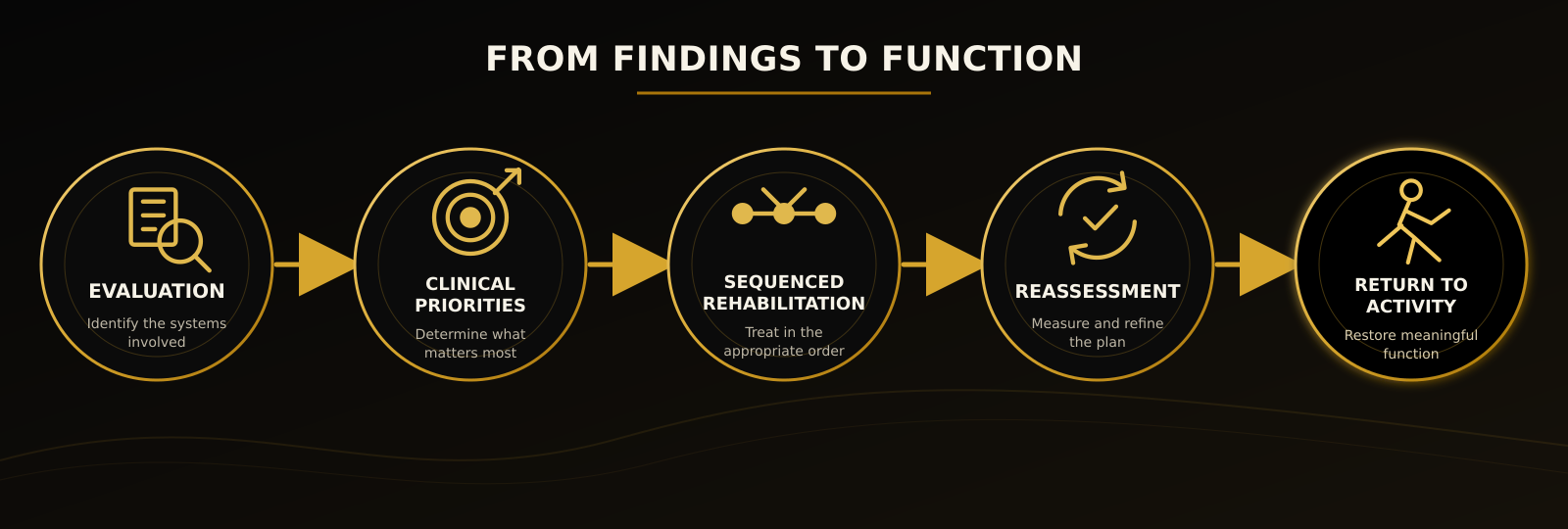
The process begins with a comprehensive evaluation to identify the systems affected by the injury, the factors limiting recovery, and the demands the patient needs to resume. These findings are then translated into a treatment plan that establishes the appropriate starting point, rehabilitation priorities, and progression strategy.
The NeuroSport approach emphasizes:
Individualized rehabilitation based on clinical findings
Integration of neurological, visual, vestibular, cervical, autonomic, cognitive, and exercise-related factors
Selection of the impairments most relevant to the patient’s symptoms and functional limitations
Careful sequencing of rehabilitation activities
Progressive increases in intensity, duration, and complexity
Monitoring of both immediate and delayed responses to activity
Reassessment to confirm progress and guide changes in care
Coordination with other healthcare professionals when additional expertise is needed
Return to the activities that matter to the patient
Treatment Is Guided by Function
Symptom improvement is important, but symptoms alone do not define recovery.
A patient may report fewer symptoms while still having difficulty with reading, screen use, balance, exercise, driving, work, school, or sport. Conversely, a patient may experience a mild and temporary symptom increase while successfully expanding activity tolerance and function.
For this reason, rehabilitation decisions consider both symptom behavior and functional progress. The clinical question is not simply whether the patient has symptoms. It is whether the patient is developing the capacity to safely and consistently meet the demands of daily life.
The Rehabilitation Plan Evolves With the Patient
The initial treatment plan is not expected to remain static throughout recovery. As one impairment improves, another limitation may become more apparent. Activities that were inappropriate early in care may become important later, while exercises that were initially beneficial may no longer provide a sufficient challenge.
The plan may evolve by:
Increasing the intensity or duration of an activity
Combining visual, vestibular, cognitive, and physical demands
Advancing from controlled clinical activities to real-world environments
Progressing cardiovascular and strength demands
Reducing accommodations as function improves
Introducing occupational or sport-specific tasks
Modifying the plan when recovery is slower or different than expected
Recovery Is Directed Toward Meaningful Goals
The purpose of concussion rehabilitation is not merely to perform exercises or normalize isolated test findings. It is to help the patient return to the roles and activities that give life meaning.
For one patient, that may mean completing a full school day. For another, it may mean returning to work without significant symptom escalation. Others may be working toward driving, caring for family, exercising, competing in sport, or participating comfortably in social and community environments.
NeuroSport uses the patient’s goals to help define the functional demands rehabilitation must ultimately address. The pathway and timeline may differ, but the direction of care remains clear: restore capacity, rebuild confidence, and support a safe, durable return to meaningful activity.
Frequently Asked Questions About Concussion Rehabilitation
How soon should concussion rehabilitation begin?
Rehabilitation may begin during the very early stages of recovery when guided by the patient’s clinical presentation and tolerance. Current concussion care generally favors a gradual return to appropriate activity rather than prolonged, complete physical and cognitive rest. Individuals who do not use activity as a recovery tool typicall take longer to recover.
The starting point will vary. Some patients can begin light aerobic or functional activity relatively early, while others initially require modifications because of significant headache, dizziness, visual dysfunction, cervical injury, orthostatic symptoms, or another complicating factor.
Can rehabilitation help with persistent concussion symptoms?
Yes. Persistent symptoms may improve when the contributing impairments are correctly identified and rehabilitation is directed toward those findings.
The continued presence of symptoms does not identify their cause. Persistent headache, dizziness, fatigue, cognitive difficulty, or exercise intolerance may involve visual, vestibular, cervical, autonomic, physiological, psychological, sleep-related, or other medical factors. A broader evaluation may be needed when recovery has stalled or treatment has not produced the expected improvement.
Is concussion rehabilitation supposed to provoke symptoms?
A mild and temporary increase in symptoms may occur when an impaired system is appropriately challenged. This does not automatically mean that the activity is harmful. Th elimiting factor is the amount of increased symptoms.
The magnitude and duration of the exercise response matter. Rehabilitation should not repeatedly produce substantial or prolonged exacerbations that significantly disrupt the patient’s function. Treatment intensity may need to be modified when symptoms increase sharply, recovery takes longer than expected, or the patient develops a delayed worsening later in the day or the following day.
How long does concussion rehabilitation take?
There is no single timeline that applies to every patient.
The duration of rehabilitation depends on factors such as the number and severity of impairments, the age of the patient, time since injury, previous concussion history, associated cervical or vestibular injury, migraine history, autonomic dysfunction, sleep, psychological health, medical conditions, and the demands of the activities the patient intends to resume.
Progress should be evaluated through changes in both symptoms and function rather than by the calendar alone.
Can concussion rehabilitation address dizziness and visual problems?
Yes, when the evaluation identifies vestibular, ocular, visual-motion, cervical, or autonomic factors contributing to those symptoms.
Dizziness and visual difficulty can have several possible causes. Rehabilitation must be directed toward the responsible system or combination of systems. Some patients may also require directed referral for neuro-optometric, vestibular, neurological, or other specialty evaluation.
When can I return to exercise or sports?
Return to exercise is usually a progressive process. The patient must first demonstrate tolerance for basic physical activity before advancing to higher cardiovascular demand, rapid movement, directional changes, cognitive-motor tasks, resistance training, sport-specific drills, and contact risk.
Feeling better at rest does not establish readiness for unrestricted sport. Return decisions should consider symptoms, examination findings, exercise tolerance, neurological function, the demands of the activity, and applicable return-to-sport requirements.
Do all patients receive the same rehabilitation exercises?
No. Patients may share a concussion diagnosis while having different impairments, symptom triggers, functional limitations, and recovery goals.
Exercises are selected according to the patient’s clinical findings and are progressed based on the response to treatment. An activity that is appropriate for one patient may be unnecessary, premature, or excessively provocative for another.
What should I do if my recovery has stopped progressing?
A plateau is a reason to reassess the clinical model rather than simply intensify the existing program.
Reassessment may identify an overlooked impairment, an inappropriate rehabilitation dosage, a need to change the sequence of treatment, or another medical factor contributing to persistent symptoms. Additional testing or coordinated specialty care may also be appropriate.
Complex Concussion Recovery Requires Experienced Clinical Leadership
Persistent concussion symptoms may involve overlapping neurological, visual, vestibular, cervical, autonomic, cognitive, and physiological impairments. Recognizing how these systems interact, determining which findings matter most, and sequencing rehabilitation appropriately require more than a standard concussion screening or a generic exercise protocol.
NeuroSport Spine & Concussion Center is led by Dr. William Moreau, a clinician and Distinguished Clinical Professor, with more than four decades of experience in sports medicine, concussion care, complex clinical evaluation, and rehabilitation.
Dr. Moreau previously served as Director of Clinics and Vice President of Sports Medicine for the United States Olympic Committee. He was Chief Medical Officer for Team USA at the Rio 2016 and PyeongChang 2018 Olympic Games and Medical Director for the London 2012 and Sochi 2014 Olympic Games. His concussion leadership has also included participation in the Berlin International Consensus Conference on Concussion in Sport and the NFL International Think Tank on Concussion Research.
This experience shapes the NeuroSport approach to concussion care.
Patients are not placed into a uniform rehabilitation program based solely on a diagnosis. Their clinical findings, symptom behavior, functional limitations, medical history, recovery stage, and individual goals are considered together. Rehabilitation is then selected, sequenced, and progressed according to the systems limiting recovery.
For patients whose symptoms have persisted, whose recovery has stalled, or whose condition has not been adequately explained, NeuroSport provides the depth of evaluation and clinical reasoning necessary to build a more precise pathway forward.
Whether the goal is returning to school, work, exercise, daily life, or competitive sport, the process begins by understanding what is preventing recovery. Secondary button:
Selected Evidence Supporting Concussion Recovery
Current evidence supports a brief period of relative rest followed by an individualized, progressive return to cognitive and physical activity. Targeted aerobic, vestibular, cervical, and other clinically indicated rehabilitation may improve recovery when prescribed according to the patient’s findings and tolerance.
Patricios JS, Schneider KJ, Dvorak J, et al. Consensus statement on concussion in sport: the 6th International Conference on Concussion in Sport, Amsterdam 2022. British Journal of Sports Medicine. 2023;57(11):695-711. doi:10.1136/bjsports-2023-106898.
Leddy JJ, Burma JS, Toomey CM, et al. Rest and exercise early after sport-related concussion: a systematic review and meta-analysis. British Journal of Sports Medicine. 2023;57(12):762-770. doi:10.1136/bjsports-2022-106676.Schneider KJ, Critchley ML, Anderson V, et al.
Targeted interventions and their effect on recovery in children, adolescents and adults who have sustained a sport-related concussion: a systematic review. British Journal of Sports Medicine. 2023;57(12):771-779. doi:10.1136/bjsports-2022-106685.
Leddy JJ, Master CL, Mannix R, et al. Early targeted heart-rate aerobic exercise versus placebo stretching for sport-related concussion in adolescents: a randomized controlled trial. The Lancet Child & Adolescent Health. 2021;5(11):792-799. doi:10.1016/S2352-4642(21)00267-4.Schneider KJ, Meeuwisse WH, Nettel-Aguirre A, et al.
Cervicovestibular rehabilitation in sport-related concussion: a randomized controlled trial. British Journal of Sports Medicine. 2014;48(17):1294-1298. doi:10.1136/bjsports-2013-093267.
Much of the strongest controlled evidence for active concussion rehabilitation has been developed in sport-related concussion populations. Application to other mechanisms, age groups, and complex clinical presentations requires individualized clinical judgment.
Written and clinically reviewed by William Moreau, DC, DACBSP, FACSM
Last clinically reviewed: August 14, 2026