
Vision Problems With Concussion, Post-Concussion Syndrome, and Dysautonomia
Vision problems are common after concussion and may persist in patients with post-concussion syndrome or dysautonomia.
Blurred vision, double vision, light sensitivity, eye fatigue, difficulty reading, and motion sensitivity can occur when the brain is no longer efficiently coordinating the eyes, balance system, autonomic nervous system, and cervical spine.
NeuroSport evaluates these interconnected systems to identify what may be interfering with visual function and recovery.
Why Concussion and Dysautonomia Can Affect Vision
Vision is not controlled by the eyes alone. The brain must coordinate eye movement, focusing, balance, spatial awareness, and the ability to process visual information.
After concussion, these neurological pathways may no longer work together efficiently. Dysautonomia can further affect visual function by altering blood flow, pupil response, sensory regulation, and tolerance for upright activity.
This disruption may contribute to:
Blurred or double vision
Light sensitivity
Eye strain
Difficulty reading
Headaches with visual activity
Dizziness in busy environments
Problems tracking moving objects
Reduced screen tolerance / eye fatigue
A routine eye examination may be normal because the problem can involve how the brain controls and integrates vision rather than the physical health of the eyes.
Common Related Vision Problems We Evaluate
Visual dysfunction may appear as a problem with clarity, eye coordination, focusing, tracking, balance, or tolerance for visually demanding activity.
Common findings include:
Convergence insufficiency
Accommodative insufficiency
Saccadic eye movement dysfunction
Smooth-pursuit dysfunction
Vestibular-ocular dysfunction
Visual motion sensitivity
Photophobia
Difficulty coordinating the eyes, head, and body
Patients may notice blurred vision, intermittent double vision, eye fatigue, headaches, losing their place while reading, difficulty following moving objects, or increased symptoms with screens, driving, stores, crowds, and other visually busy environments.
Vision Problems After Concussion and Post-Concussion Syndrome
Visual symptoms are common after concussion and may continue when recovery is prolonged.
Blurred vision, double vision, light sensitivity, difficulty reading, and eye fatigue may occur when the brain is not efficiently coordinating visual input, eye movement, balance, and attention.
In patients with persistent symptoms, visual dysfunction can also contribute to headaches, dizziness, cognitive fatigue, motion sensitivity, and difficulty returning to school, work, exercise, or driving.
Even when vision symptoms are not the patient’s primary complaint, they may still be an important part of the recovery problem.
Vision Problems With Dysautonomia and POTS
The autonomic nervous system helps regulate blood pressure, heart rate, pupil response, cerebral blood flow, and the body’s response to physical and visual stress.
When autonomic regulation is impaired, patients may experience blurred vision, visual dimming, light sensitivity, difficulty focusing, dizziness, or increased symptoms while standing, reading, using screens, or moving through visually busy environments.
These symptoms may reflect more than an eye problem. They can result from the interaction between autonomic dysfunction, altered sensory processing, migraine, and reduced tolerance for upright activity.
How Common Is Visual Dysfunction?
Visual symptoms are among the most common problems reported after concussion, particularly in children, adolescents, and patients whose symptoms persist beyond the expected recovery period.
The American Academy of Pediatrics reports that blurred vision, light sensitivity, and double vision occur in up to 40% of children and adolescents immediately after concussion.
The prevalence is even higher in patients with prolonged symptoms. Research from specialty concussion clinics has found that:
Approximately 69% of pediatric concussion patients had at least one associated vision disorder
Approximately 62.5% of children and adolescents with persistent symptoms had a vision-related dysfunction
Vergence deficits were identified in 62% of persistently symptomatic pediatric patients
Accommodation deficits were identified in 76% of persistently symptomatic pediatric patients
These findings are important because visual dysfunction may not always be recognized as the primary complaint. A patient may report headache, fatigue, dizziness, difficulty concentrating, or reduced reading tolerance without realizing that impaired eye coordination or focusing is contributing to the problem.
In adults with persistent post-concussion symptoms, blurred vision and double vision are also reported, although they occur less frequently than headache, fatigue, and dizziness. Even when visual symptoms are not the most prominent complaint, they may still interfere with reading, computer use, driving, balance, work, and exercise.
The high frequency of these problems supports routinely evaluating visual function after concussion rather than waiting for the patient to specifically report an eye-related complaint.
Why Vision Problems Are Often Missed
Many patients with concussion-related visual dysfunction can still have adequate visual accuity where they can read an eye chart and most likely have a normal structural eye examination.
The vision difficulty in this patient population may more likely involve how the brain controls eye movement, focusing, balance, visual attention, and motion processing rather than a problem with the eye itself. This may represent more of a neurogical interuption in brain based messaging than a physical injury to the eye.
Symptoms may also be described indirectly as headache, dizziness, fatigue, poor concentration, motion sensitivity, or difficulty reading. Without specific testing of convergence, accommodation, saccades, smooth pursuits, and vestibular-ocular function, the visual component may go unrecognized. It is not uncommon for standardized eye examinations to not identify these brain messaging issues.
How Visual Dysfunction Affects Daily Life
Visual dysfunction can certainly interfere with much more than eyesight. Patients may struggle with reading, computer work, driving, school, exercise, sports, grocery stores, crowds, and other visually demanding environments. Balance problems are often associated with visual dysfunction.
Children and adolescents may develop headaches during class, lose their place while reading, avoid homework, or appear inattentive when the underlying problem is visual fatigue or impaired eye coordination.
Adults may experience reduced work tolerance, difficulty shifting focus between screens and documents, increased symptoms while driving, or worsening fatigue as visual demand builds throughout the day.
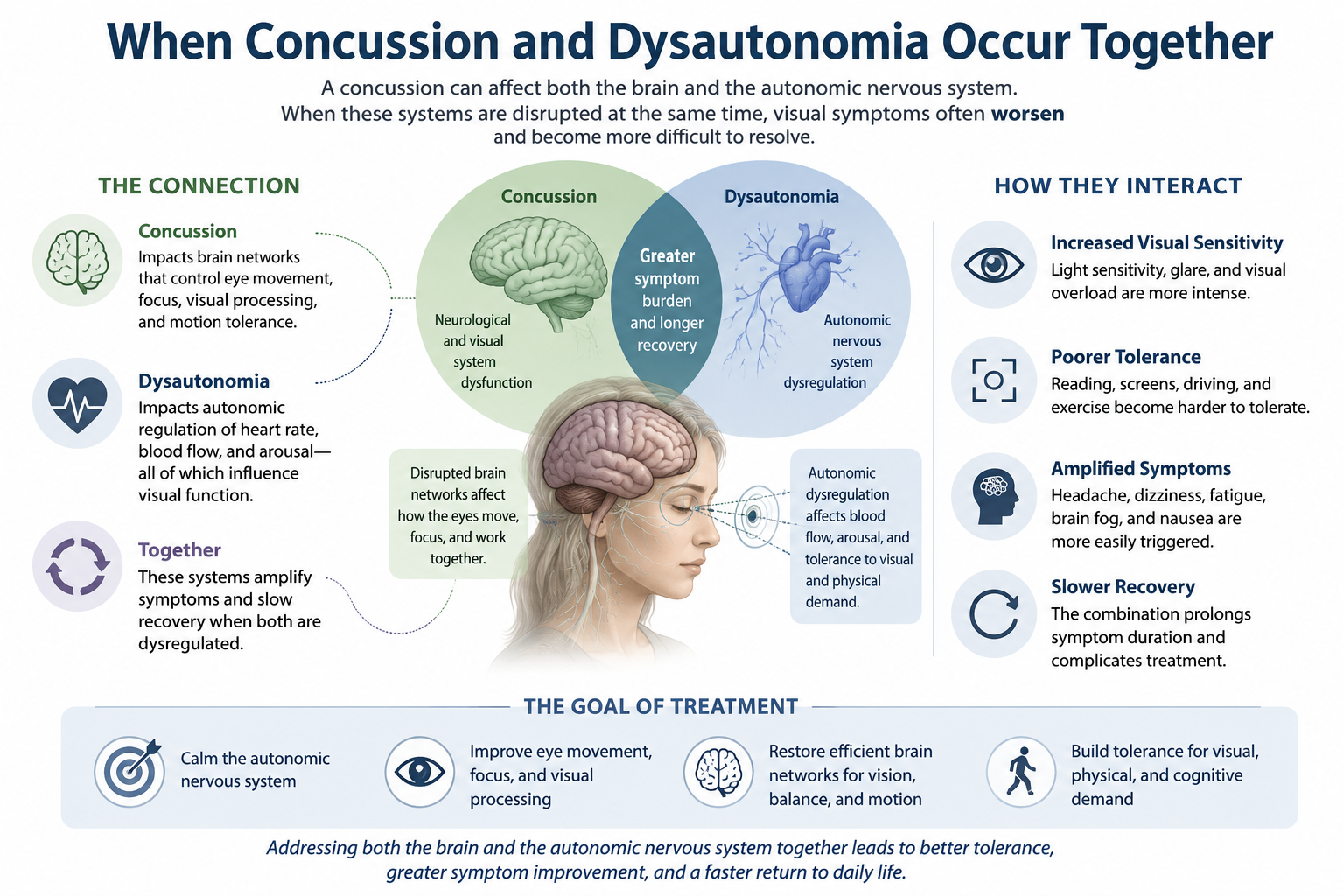
When Concussion and Dysautonomia Occur Together
Concussion can disrupt both visual processing and autonomic regulation. When these systems are affected at the same time, patients may develop a more complex pattern of symptoms that is difficult to explain through a routine eye examination alone.
Visual symptoms may worsen as the patient remains upright, becomes physically active, performs sustained near work, or moves through a visually demanding environment. Reading, computer use, driving, grocery stores, crowds, and rapid head movement may all increase symptoms.
Patients may experience:
Blurred or dimmed vision while standing
Intermittent double vision
Increased light sensitivity
Eye fatigue with reading or screen use
Dizziness or nausea in visually busy environments
Difficulty stabilizing vision while walking
Headaches triggered by visual activity
Reduced concentration as visual demand increases
Worsening symptoms as heart rate rises
Increased motion sensitivity
Difficulty coordinating the eyes, head, and body
These symptoms may reflect an interaction between impaired eye movement control, vestibular dysfunction, altered cerebral blood flow, sensory hypersensitivity, migraine, cervical dysfunction, and autonomic instability.
This is why treating only the eyes, only the neck, or only the autonomic nervous system may fail to address the full problem. A more complete evaluation is needed to determine which systems are contributing and how they are interacting.
The NeuroSport Vision Evaluation
At NeuroSport, vision is evaluated as part of the broader neurological, vestibular, autonomic, and cervical examination.
The goal is not simply to determine whether a patient has blurred vision, double vision, or light sensitivity. The goal is to identify which systems are not working together correctly and what may be preventing recovery.
Depending on the patient’s symptoms and history, the evaluation may include:
Visual acuity screening
Pupillary responses
Cranial nerve function
Eye alignment
Near point of convergence
Accommodation and focusing ability
Saccadic eye movements
Smooth-pursuit tracking
Gaze stability
Vestibular-ocular reflex function
Visual motion sensitivity
Eye-head coordination
Balance and postural control
Cervical spine contribution
Autonomic testing
Symptom response to cognitive and physical activity
This broader approach helps distinguish between an eye-health problem and a neurological coordination problem.
A patient may have healthy eyes and a normal glasses prescription but still struggle because the brain is not efficiently coordinating visual input with balance, movement, attention, and autonomic regulation.
The evaluation also helps determine whether care can be managed at NeuroSport or whether referral to an optometrist, neuro-optometrist, ophthalmologist, neuro-ophthalmologist, neurologist, or vestibular specialist is appropriate.
Evidence-Guided Treatment and Rehabilitation
There is no single treatment for every vision problem associated with concussion, post-concussion syndrome, dysautonomia, or POTS.
Treatment must be based on the specific dysfunction identified during the examination. A patient with convergence insufficiency requires a different approach than a patient whose symptoms are primarily related to vestibular dysfunction, autonomic instability, cervical injury, migraine, or visual motion sensitivity.
Depending on the findings, care may include:
Convergence and binocular coordination exercises
Accommodation and focusing retraining
Saccadic eye movement rehabilitation
Smooth-pursuit tracking exercises
Gaze-stability training
Vestibular rehabilitation
Visual-motion desensitization
Eye-head coordination exercises
Balance and postural-control training
Cervical spine treatment
Autonomic rehabilitation
Graduated cardiovascular exercise
Return-to-learn or workplace accommodations
Activity pacing and symptom-management strategies
These exercises must be carefully dosed. Too much visual stimulation can worsen headache, dizziness, nausea, fatigue, and autonomic symptoms.
The goal is not to provoke symptoms aggressively. The goal is to provide enough challenge to improve neurological coordination without overwhelming the patient’s ability to recover.
As function improves, visual and physical demands are gradually advanced toward the activities that matter most to the patient, including reading, school, work, driving, exercise, and sports.
When Referral to an Eye or Vision Specialist Is Needed
NeuroSport evaluates vision-related symptoms routinely and refers patients when additional specialty examination or treatment is indicated. Referral may be appropriate when there is concern for:
Persistent or worsening double vision
Persistent sensitivity to light
Visual-field loss
Cranial nerve dysfunction
Strabismus or significant eye misalignment
Retinal or optic nerve disease
New or unexplained vision loss
Significant refractive change
Complex binocular vision dysfunction
Need for prism, specialty lenses, or advanced optical treatment
Symptoms that do not respond as expected to rehabilitation
Depending on the findings, care may involve a neuro-optometrist, ophthalmologist, neuro-ophthalmologist, neurologist, or vestibular rehabilitation specialist.
The purpose of referral is not to separate vision from the rest of the patient’s condition. It is to build the right care team around the patient when the visual, vestibular, autonomic, and neurological systems all require attention.
NeuroSport continues to coordinate care so that treatment remains connected to the patient’s broader recovery goals, including reading, school, work, driving, exercise, and sport.
Vision Warning Signs That Require Urgent Evaluation
Most vision symptoms associated with concussion, post-concussion syndrome, or dysautonomia are not medical emergencies. However, some findings may indicate a more serious neurological or eye condition and should be evaluated promptly.
Seek urgent medical attention for:
Sudden loss of vision
A new visual-field deficit
Persistent or rapidly worsening double vision
New unequal pupils
New eyelid drooping
Severe eye pain
A sudden increase in headache severity
Repeated vomiting
New weakness or numbness
Slurred speech
Increasing confusion
Seizure
Loss of consciousness
Rapid neurological deterioration
These symptoms should not be assumed to be part of a routine concussion recovery.
New or worsening visual symptoms after another head impact also require reassessment, even if the original concussion appeared to be improving.
When symptoms are less urgent but continue to interfere with reading, school, work, driving, exercise, or daily activity, a comprehensive evaluation is still appropriate. Persistent visual dysfunction can slow recovery and may contribute to headache, dizziness, fatigue, and reduced tolerance for physical or cognitive activity.
Vision Problems Can Affect the Entire Recovery
Vision is involved in nearly every waking activity. When visual function is impaired, patients may struggle with reading, school, work, driving, exercise, balance, and visually demanding environments.
These symptoms can also amplify headache, dizziness, neck tension, cognitive fatigue, motion sensitivity, and autonomic symptoms.
A normal eye examination or brain scan does not always identify the problem. In many cases, the difficulty involves how the brain coordinates visual input with balance, movement, attention, and autonomic regulation.
Identifying the visual component of concussion, post-concussion syndrome, or dysautonomia can provide an important missing piece of the recovery process.
Schedule a NeuroSport Evaluation
Persistent blurred vision, double vision, light sensitivity, eye fatigue, reading difficulty, dizziness, or motion sensitivity should not be dismissed. NeuroSport evaluates how the visual, vestibular, neurological, cervical, and autonomic systems are functioning together in concussion and d.
A detailed evaluation can help determine:
What is contributing to the symptoms
Which systems require rehabilitation
Whether visual symptoms are linked to concussion, dysautonomia, cervical dysfunction, or another condition
Whether referral to an eye or vision specialist is appropriate
How care can support return to school, work, driving, exercise, and sport
Related NeuroSport Resources
Concussion and Post-Concussion Treatment
Concussion Treatment in Vancouver, WA Why Post-Concussion Symptoms Persist
Post-Concussion Syndrome: Why Symptoms Persist Concussion and Autonomic Dysfunction
Concussion Can Disrupt the Autonomic Nervous System Can Concussion Cause POTS?
Can Concussion Cause POTS? Normal Imaging With Persistent Symptoms
Why Imaging May Appear Normal Despite Persistent Symptoms Exercise Intolerance
Exercise Intolerance in Concussion and Dysautonomia Moreau POTS Protocol
The Moreau POTS Protocol NeuroSport Knowledge Center
Explore the NeuroSport Knowledge Center
Further Reading
Vision and Concussion: Symptoms, Signs, Evaluation, and Treatment. American Academy of Pediatrics
https://publications.aap.org/pediatrics/article/150/2/e2021056047/188533/Vision-and-Concussion-Symptoms-Signs-EvaluationReviews common concussion-related vision problems, including convergence insufficiency, accommodative insufficiency, saccadic dysfunction, smooth-pursuit dysfunction, blurred vision, double vision, and difficulty reading.
Post-Concussion Clinical Findings of Oculomotor Function in Pediatric Patients With Persisting Symptoms
PubMed https://pubmed.ncbi.nlm.nih.gov/40905935/ This study identified vergence deficits in 62% and accommodative deficits in 76% of persistently symptomatic pediatric concussion participants.Neuro-Visual Pathway After Mild Traumatic Brain Injury: A Systematic Scoping Review
Acta Neurologica Belgica https://link.springer.com/article/10.1007/s13760-026-03101-0 A 2026 review examining visual symptoms, objective testing, and rehabilitation following mild traumatic brain injury.Synergistic but Separable Sensory Changes in Postural Tachycardia Syndrome and Chronic Migraine
PubMed https://pubmed.ncbi.nlm.nih.gov/33174112/This study found lower light-sensitivity thresholds in patients with POTS, supporting an association between autonomic dysfunction, sensory sensitization, and photophobia.